When Math Was Discovered: A Complete History of Mathematics
When was math discovered?
The short answer: Math was not discovered at one specific time. It developed gradually over thousands of years as humans needed ways to count, measure, build, and solve problems.
In this article, we’ll explore:
- When math was first used
- Who discovered math
- Which civilization invented mathematics
- How algebra, geometry, and zero were developed
Let’s break it down clearly.
When Was Math First Discovered?
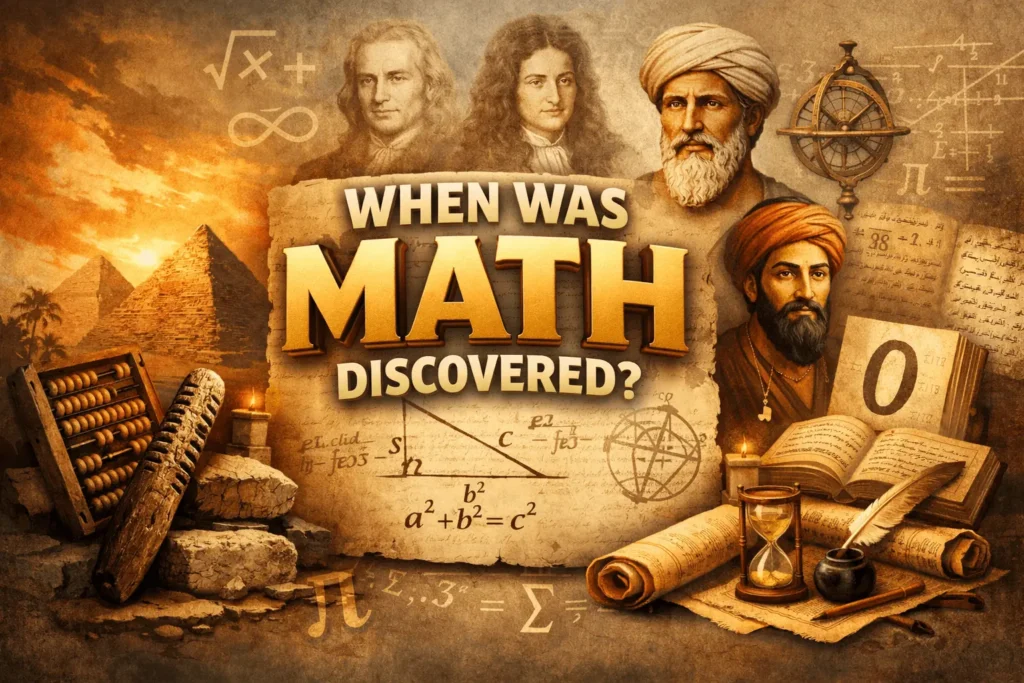
Basic math concepts date back at least 20,000 years.
Archaeologists discovered the Ishango Bone, a prehistoric tool with tally marks carved into it. These marks were likely used for counting.
This shows that early humans understood basic number systems long before written history.
So if you’re asking:
When was math discovered?
👉 Primitive counting systems existed around 20,000 BCE or earlier.
👉Make Math Fun, Fast and Fearless!
The Origin of Mathematics in Ancient Civilizations
As civilizations grew, math became more advanced.
1. Ancient Egyptians (3000 BCE)
The Egyptians used mathematics for:
- Building pyramids
- Measuring land after floods
- Managing trade
They developed early geometry and fractions.
2. Babylonians (2000 BCE)
The Babylonians created:
- Early algebra
- Advanced arithmetic
- A base-60 number system (which is why we have 60 minutes in an hour)
They solved equations long before modern calculators existed.
3. Ancient Greeks (600–300 BCE)
Greek mathematicians helped formalize mathematics into logical proofs.
Key figures:
- Pythagoras – Pythagorean Theorem
- Euclid – “Father of Geometry” (wrote Elements)
- Archimedes – Major discoveries in geometry and measurement
This period shaped much of the math we still use today.
Who Discovered Math?
No single person discovered math.
Instead, mathematics was developed by many cultures, including:
- Egyptians
- Babylonians
- Greeks
- Indians
- Islamic scholars
- European mathematicians
Math evolved as human knowledge expanded.
Who Invented Zero?
One of the biggest breakthroughs in mathematics was the invention of zero as a number.
Around the 5th century CE, Indian mathematicians formally developed zero.
Later, Persian mathematician Al-Khwarizmi (9th century) expanded algebra and introduced systematic methods for solving equations.
Fun fact:
The word “algorithm” comes from Al-Khwarizmi’s name.

When Was Modern Math Developed?
Modern mathematics began developing around the 1600s.
Two major figures:
- Isaac Newton
- Gottfried Wilhelm Leibniz
They independently developed calculus, which is now essential in physics, engineering, economics, and computer science.
From there, math expanded into:
- Statistics
- Probability
- Cryptography
- Computer algorithms
Why Do Some Kids Find Math Hard?
Even though math has been around for thousands of years, many children still struggle with it today.
Here’s why:
1. Weak Foundations
Math builds step by step. Missing basics makes advanced topics harder.
2. Math Anxiety
Fear reduces focus and working memory.
3. Learning Differences
Some children have dyscalculia, ADHD, or processing challenges.
4. Teaching Style
Some kids learn better visually or hands-on.
5. Fixed Mindset
Believing “I’m bad at math” lowers performance.
Research shows most children can improve with practice and the right support.
Is Math Easy to Learn?
Yes — math can be easy if:
- You understand the basics first
- You practice consistently
- You break problems into small steps
Math follows clear patterns and logical rules. Once you understand the system, it becomes easier over time.
Final Answer: When Was Math Discovered?
- Basic counting: 20,000+ years ago
- Organized math systems: 3000 BCE
- Zero developed: 5th century CE
- Algebra expanded: 9th century CE
- Calculus created: 1600s
Math was not invented in one moment.
It evolved as humans needed better tools to understand the world.
And today, mathematics continues to grow — especially in technology and artificial intelligence.