When Do You Cross Multiply Fractions?
Cross multiplication is a useful shortcut when working with fractions, but it is not something you use for every fraction problem.
So, when do you cross multiply fractions?
You can use cross multiplication when you are comparing two fractions, checking whether two fractions are equivalent, or solving a proportion with an unknown value.
You should not automatically cross multiply when adding, subtracting, multiplying, or dividing fractions. Those operations have their own methods.
Let’s look at exactly when cross multiplication works and when you should use something else.
What Does Cross Multiplying Fractions Mean?
Suppose you have two fractions:
a/b and c/d
To cross multiply, multiply diagonally:
a × d
and
c × b
These are called the cross products.
For example:
3/5 and 4/7
Cross multiply:
3 × 7 = 21
4 × 5 = 20
Because 21 is greater than 20:
3/5 > 4/7
Cross multiplication lets us compare the fractions without first finding a common denominator.
When Do You Cross Multiply Fractions?
There are three common situations where cross multiplication is useful.
1. When Comparing Two Fractions
Cross multiplication can be used to determine which of two fractions is greater.
For example:
5/8 or 2/3
Cross multiply:
5 × 3 = 15
2 × 8 = 16
Since 16 is greater than 15:
2/3 > 5/8
This is especially useful when the fractions have different denominators and the comparison isn’t immediately obvious.
2. When Checking Whether Two Fractions Are Equivalent
You can also cross multiply to check whether two fractions represent the same value.
For example:
3/4 = 6/8
Cross multiply:
3 × 8 = 24
6 × 4 = 24
The cross products are equal, so the fractions are equivalent.
Therefore:
3/4 = 6/8
3. When Solving a Proportion
Cross multiplication is also commonly used when you need to find a missing value in a proportion.
For example:
3/4 = x/20
Cross multiply:
3 × 20 = 4 × x
So:
60 = 4x
Divide both sides by 4:
x = 15
Therefore:
3/4 = 15/20
This is one of the most common uses of cross multiplication in later math.
When Should You NOT Cross Multiply Fractions?
This is where many students get confused.
Cross multiplication is not a general-purpose method for every fraction operation.
Adding Fractions
You don’t simply cross multiply to add fractions.
For example:
1/3 + 1/4
The denominators are different, so you need a common denominator.
The least common denominator is 12:
1/3 = 4/12
1/4 = 3/12
Now add:
4/12 + 3/12 = 7/12
The standard method is to find a common denominator and then add the numerators.
Subtracting Fractions
The same principle applies to subtraction.
For example:
3/4 – 1/6
Find a common denominator:
3/4 = 9/12
1/6 = 2/12
Then subtract:
9/12 – 2/12 = 7/12
Don’t treat cross multiplication as a shortcut for subtracting the fractions.
Multiplying Fractions
When multiplying fractions, you multiply straight across.
For example:
2/3 × 4/5
Multiply the numerators:
2 × 4 = 8
Multiply the denominators:
3 × 5 = 15
So:
2/3 × 4/5 = 8/15
There is no need to cross multiply.
Dividing Fractions
When dividing fractions, use the reciprocal of the second fraction and multiply.
For example:
2/3 ÷ 4/5
Change division to multiplication and flip the second fraction:
2/3 × 5/4
Then:
10/12 = 5/6
Again, cross multiplication is not the standard method for the operation.
A Simple Rule to Remember
If you’re wondering “When do I cross multiply fractions?”, remember:
COMPARE, CHECK, OR SOLVE.
COMPARE
Use cross multiplication to compare two fractions.
3/5 ? 4/7
CHECK
Use it to check whether two fractions are equivalent.
3/4 ? 6/8
SOLVE
Use it to solve a proportion with an unknown.
3/4 = x/20
But don’t use cross multiplication as your automatic method for adding, subtracting, multiplying, or dividing fractions.
Why Does Cross Multiplication Work?
There is a reason the method works.
Take:
3/5 and 4/7
If we wanted to compare them using a common denominator, we could rewrite them as:
21/35
and
20/35
Now it is obvious that:
21/35 > 20/35
The 21 and 20 came from the same cross products:
3 × 7 = 21
4 × 5 = 20
So cross multiplication gives us the information we need to compare the fractions without writing out the common denominator.
What If the Denominators Are the Same?
You usually don’t need cross multiplication when the denominators are already the same.
For example:
3/8 and 5/8
Both fractions have a denominator of 8.
Simply compare the numerators:
5 > 3
Therefore:
5/8 > 3/8
Cross multiplication would work, but it would be unnecessary extra work.
What If the Numerators Are the Same?
If the numerators are the same and the fractions are positive, you can often compare the denominators directly.
For example:
3/5 and 3/8
The smaller denominator means larger pieces.
Therefore:
3/5 > 3/8
Again, cross multiplication would work, but you don’t need it for such an obvious comparison.
Can You Cross Multiply Mixed Numbers?
Before cross multiplying, convert mixed numbers to improper fractions.
For example:
1 1/2
becomes:
3/2
If you need to compare:
1 1/2 and 7/5
first convert:
3/2 and 7/5
Then cross multiply:
3 × 5 = 15
7 × 2 = 14
Therefore:
3/2 > 7/5
So:
1 1/2 > 7/5
Common Cross Multiplication Mistakes
Mistake 1: Multiplying straight across
For comparison, don’t multiply numerator by numerator and denominator by denominator.
The cross products are diagonal.
For:
a/b and c/d
use:
a × d
and:
c × b
Mistake 2: Using cross multiplication for every fraction problem
Cross multiplication is useful, but it isn’t the solution to every fraction operation.
Remember:
- Compare → cross multiplication can help
- Equivalent fractions → cross multiplication can help
- Proportions → cross multiplication can help
- Add → common denominator
- Subtract → common denominator
- Multiply → multiply straight across
- Divide → multiply by the reciprocal
Mistake 3: Forgetting what the products mean
When comparing fractions, the larger cross product corresponds to the larger fraction when the denominators are positive.
For example:
5/6 and 3/4
Cross multiply:
5 × 4 = 20
3 × 6 = 18
Because 20 is greater than 18:
5/6 > 3/4
Quick Cross Multiplication Practice
Try these problems yourself.
1. Which fraction is greater?
2/5 or 3/7
Cross multiply:
2 × 7 = 14
3 × 5 = 15
Answer:
3/7 > 2/5
2. Which fraction is greater?
4/9 or 5/11
Cross multiply:
4 × 11 = 44
5 × 9 = 45
Answer:
5/11 > 4/9
3. Find the missing number.
2/3 = x/12
Cross multiply:
2 × 12 = 3x
24 = 3x
x = 8
So:
2/3 = 8/12
Final Answer: When Do You Cross Multiply Fractions?
Cross multiplication is most useful when you need to:
- Compare two fractions
- Check whether two fractions are equivalent
- Solve a proportion for a missing value
It is not the standard method for directly multiplying or dividing fractions, and you should not automatically use it whenever you see fractions.
The easiest way to remember it is:
Compare, check, or solve — that’s when cross multiplication can help.
Once you understand when to use the method and when to use another fraction strategy, fraction problems become much easier to approach.
Want More Fraction Practice?
If you’re looking for printable fraction practice for elementary students, Eshaal Maths also has fraction worksheets covering important skills such as comparing fractions and understanding fractions on number lines.
Explore Eshaal Maths Printable Math Resources →
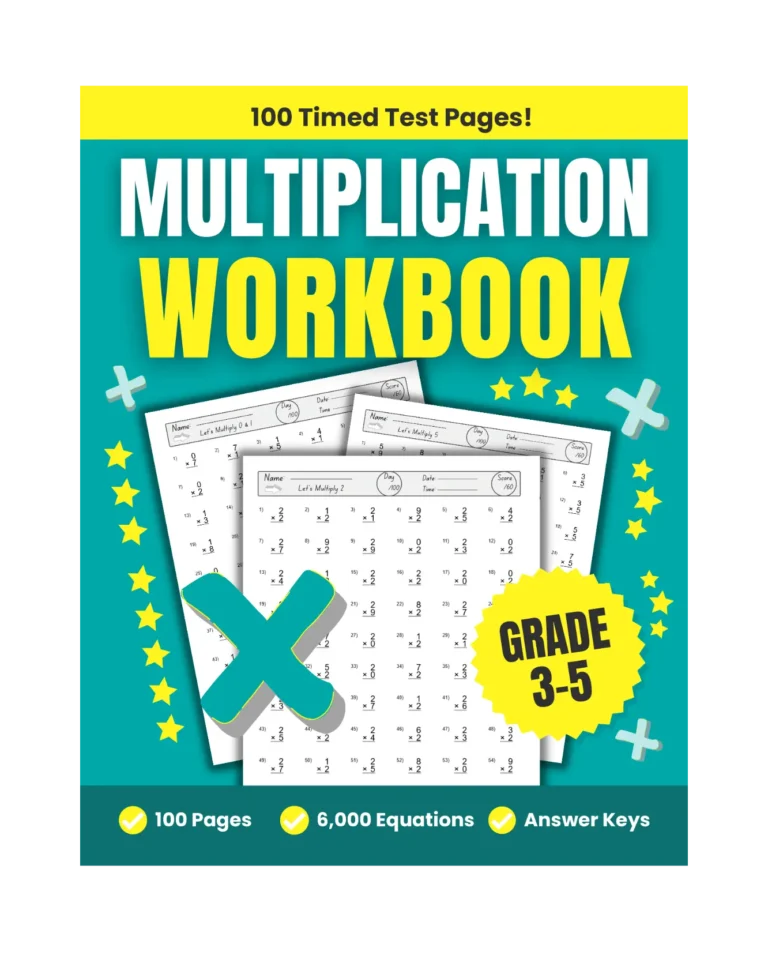
For students who prefer a physical workbook, Eshaal Maths also publishes math practice books on Amazon.