
How to Teach Long Division: 7 Easy, Proven Steps to Help Kids Master It (2026 Guide)
Long division scares a lot of kids. It looks messy, it has four steps that repeat, and one small mistake throws off the whole answer.
But here’s the good news: once you break it down, long division is just a pattern. Repeat the same four moves until you run out of numbers. That’s it.
This guide shows you how to teach long division step by step, with tricks, common mistakes, and fun ways to practice — all built for parents and teachers working with kids in 4th and 5th grade.
What Is Long Division? (Quick Refresher Before You Teach It)
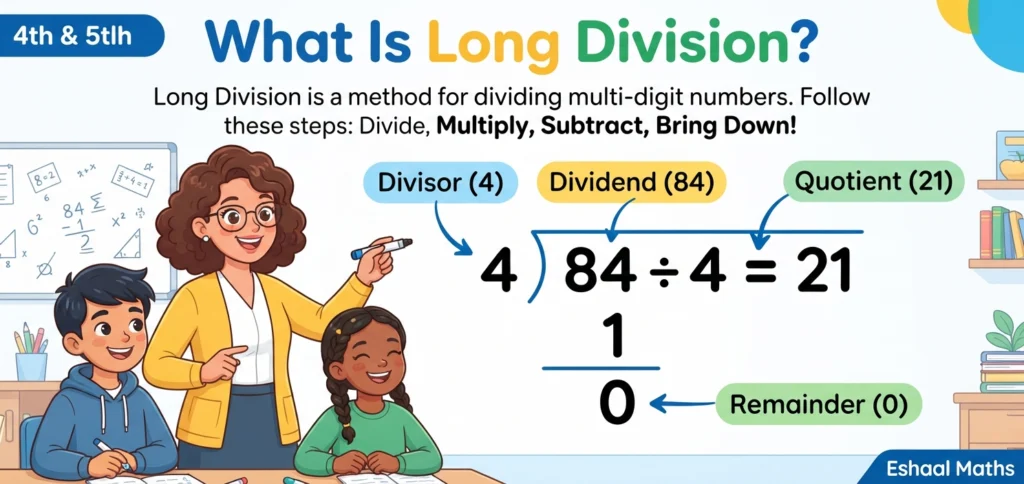
Before diving into the long division method, kids need to know four words.
- Dividend – the number being divided (it sits inside the division bracket)
- Divisor – the number doing the dividing (it sits outside the bracket)
- Quotient – the answer
- Remainder – what’s left over when the divisor doesn’t fit evenly
The National Council of Teachers of Mathematics (NCTM) and most U.S. state standards place long division in 4th and 5th grade math. By 5th grade, kids are expected to divide multi-digit numbers and explain the process, not just get the right answer.
Why does this method matter? Short division works fine for single-digit divisors. But once the divisor has two or more digits — like dividing by 24 or 39 — long division gives kids a structured way to track every step on paper instead of relying on mental math that’s easy to mess up.
How to Teach Long Division in 7 Easy Steps
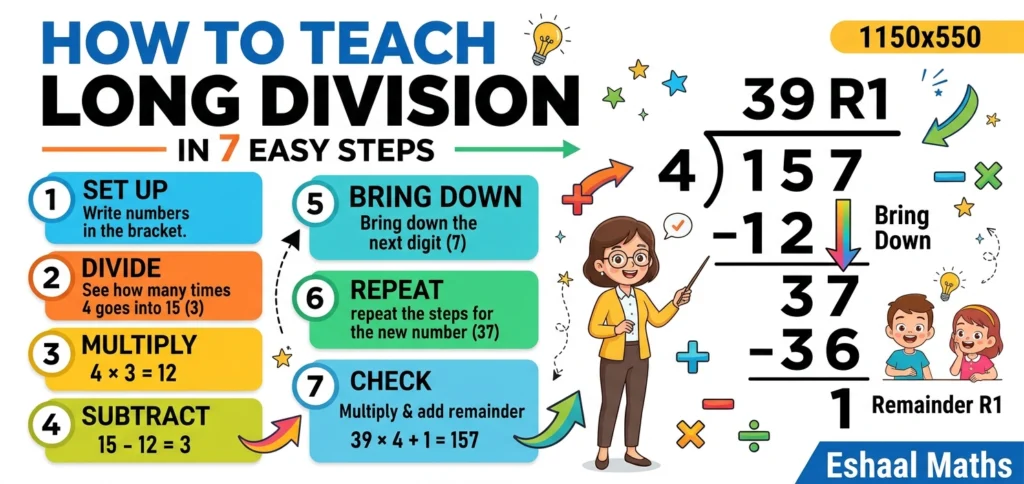
Here’s how to teach long division so it actually sticks. The method never changes — only the numbers do.
Step 1: Set up the problem correctly. Write the dividend inside the bracket and the divisor outside. Place value matters here. A sloppy setup causes most early mistakes.
Step 2: Divide. Ask: how many times does the divisor fit into the first digit (or first few digits) of the dividend? Write that number on top, directly above the digit you used.
Step 3: Multiply. Multiply the number you just wrote by the divisor. Write the product underneath.
Step 4: Subtract. Subtract that product from the part of the dividend you were working with. The result should always be smaller than the divisor — if it isn’t, the divide step was wrong.
Step 5: Bring down the next digit. Drop the next digit of the dividend down next to your subtraction answer. This creates a new number to divide.
Step 6: Repeat. Go back to divide, multiply, subtract, bring down — again and again until there are no more digits left to bring down.
Step 7: Check the answer. Multiply the quotient by the divisor, then add any remainder. If it matches the original dividend, the answer is correct.
Here’s a full worked example: 157 ÷ 4.
4 doesn’t go into 1, so look at 15. 4 goes into 15 three times (3 × 4 = 12). Subtract: 15 − 12 = 3. Bring down the 7, making 37. Divide again: 4 goes into 37 nine times (9 × 4 = 36). Subtract: 37 − 36 = 1. No digits left to bring down, so 1 is the remainder.
Final answer: 157 ÷ 4 = 39 R1.
What about remainders? A remainder can be written three ways:
- As a whole number remainder (R1)
- As a fraction (1/4)
- As a decimal (add a decimal point and zeros to the dividend, then keep dividing — this gives 39.25)
You May Like This Post As Well: Long Division Worksheets – Free Printable PDF With Answer Key
Fun Long Division Activities and Tricks Kids Actually Enjoy
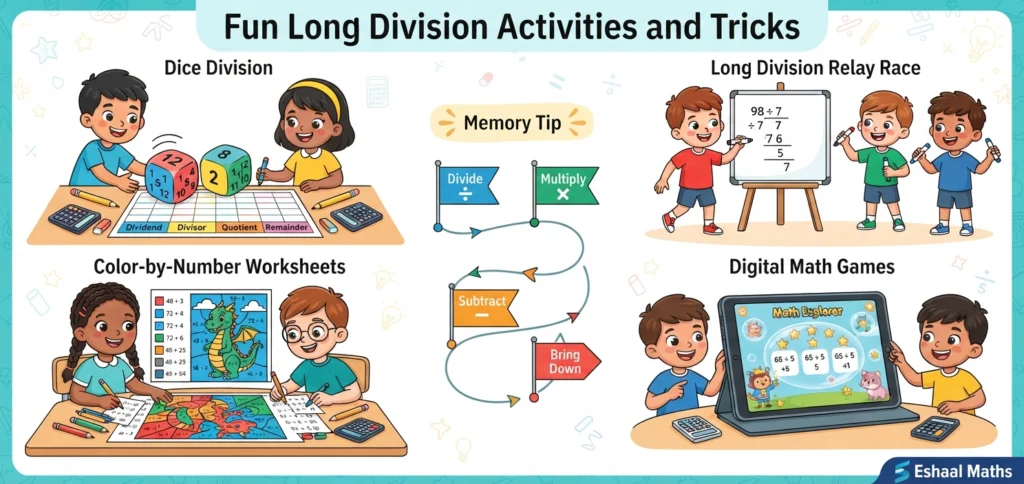
Drilling the same worksheet over and over kills motivation fast. Mixing in memory tricks and hands-on practice keeps kids engaged while they build fluency.
What is the KFC method in math? KFC is a simple memory trick some teachers use: Keep, Change, Flip — though that trick is actually for dividing fractions, not whole-number long division. For long division itself, the more common mnemonic is “Does McDonald’s Sell Cheese Burgers Raw?” — each word stands for Divide, Multiply, Subtract, Check, Bring down, Repeat/Remainder. Other classrooms use “Dad, Mom, Sister, Brother, Rover” for the same five-step pattern.
Fun ways to practice long division that go beyond pencil and paper:
- Dice division – roll dice to build a random dividend and divisor, then solve it
- Long division relay races – kids pass a problem down the row, each solving one step
- Color-by-number worksheets – the quotient reveals a hidden picture
- Digital games and apps – tools like IXL or Prodigy turn repetition into a game format
- Real-world word problems – splitting a pizza budget or dividing a classroom snack count
A quick daily 5-minute challenge — just one or two problems a day — builds long-term fluency far better than one long weekly worksheet session, based on general findings from math fluency research on spaced, frequent practice.
Common Long Division Mistakes (and How to Fix Them)
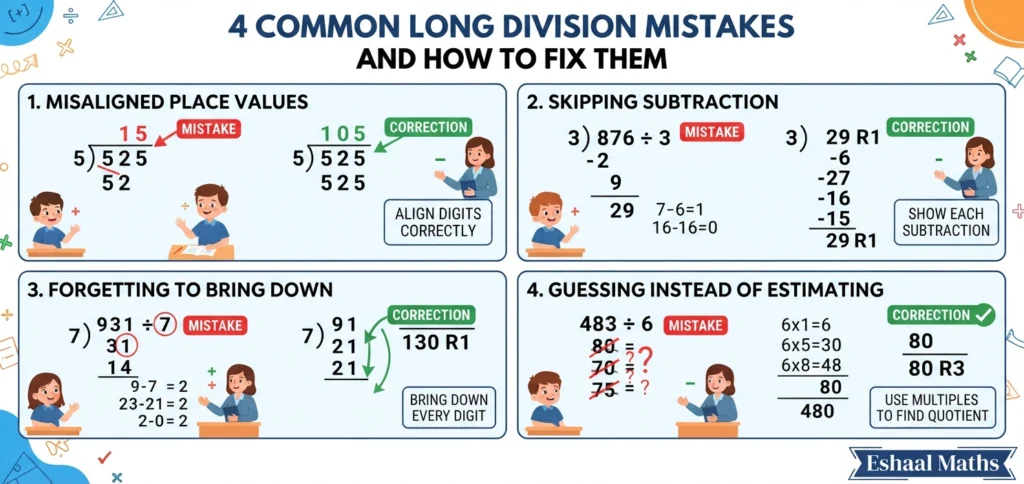
Most errors in long division trace back to one of these four habits.
Misaligned place values. If digits aren’t lined up in neat columns, the whole answer shifts. Using grid paper or graph paper keeps columns straight.
Skipping the subtract-and-check step. Kids rush and forget to confirm the subtraction result is smaller than the divisor. If it isn’t, the divide step was too low.
Forgetting to bring down the next digit. This is the step most often skipped under time pressure. Writing the four steps (Divide, Multiply, Subtract, Bring Down) at the top of the page as a checklist helps.
Guessing instead of estimating with multiples. Kids who don’t know their multiplication facts well tend to guess the quotient digit. Listing the first nine multiples of the divisor before starting removes the guesswork.
Other Ways to Teach Long Division (Pick What Fits Your Child)
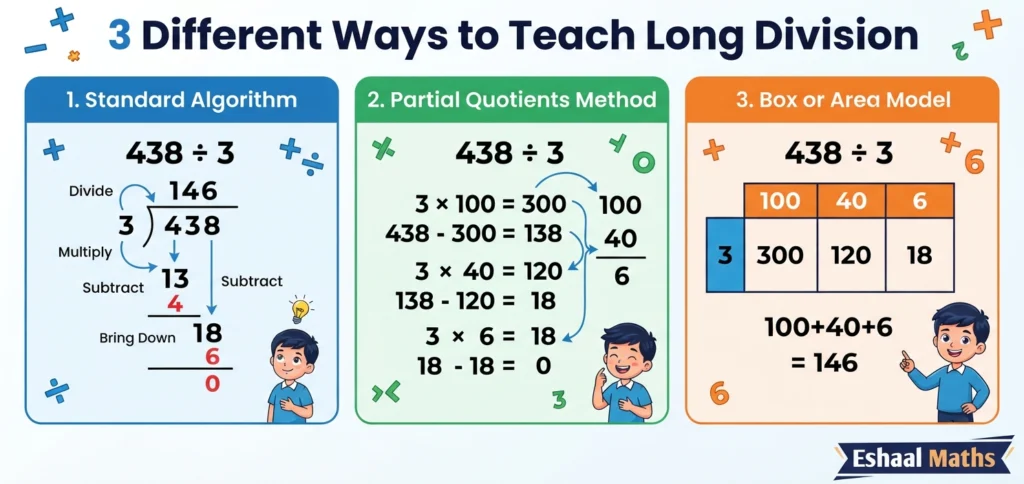
The standard algorithm isn’t the only option, and the new way of teaching long division in many classrooms leans on these alternatives first.
Partial quotients method (sometimes called the “Big 7” method) lets kids subtract any multiple of the divisor they’re confident with, rather than finding the exact quotient digit in one shot. It’s more forgiving for kids still building multiplication fluency.
Box or area model breaks the dividend into friendly chunks (hundreds, tens, ones) and divides each chunk separately, then adds the results. This method makes the connection between multiplication and division very visual.
Which should you choose? If your child is fast and confident with multiplication facts, the standard algorithm is quickest. If they’re still shaky on facts, partial quotients or the area model build understanding first and transition into the standard method later.
FAQs About Teaching Long Division
How can I teach long division to my child?
Start by reviewing multiplication facts and short division. Then teach the four-step pattern — divide, multiply, subtract, bring down — using one worked example at a time before moving to independent practice.
What is the new way of teaching long division?
Many schools now introduce the partial quotients method before the standard algorithm. It lets kids subtract manageable chunks of the divisor instead of finding the exact digit immediately, which builds confidence before speed.
What is a trick for doing long division?
Listing the first nine multiples of the divisor before starting removes guesswork. Mnemonics like “Does McDonald’s Sell Cheese Burgers Raw” also help kids remember the step order: Divide, Multiply, Subtract, Check, Bring down, Repeat.
What are some fun activities to practice long division?
Dice division games, color-by-number worksheets, relay races, and digital math apps all turn repetitive practice into something kids look forward to.
How do you teach long division in a fun way?
Mix short daily practice (5 minutes) with games instead of long worksheets. Use real-world word problems — like splitting snacks or allowance — so the math feels useful, not abstract.
What is the KFC method in math?
KFC stands for Keep, Change, Flip — a trick used for dividing fractions, not whole-number long division. It’s a different skill but often gets confused with long division tricks because both involve division.
Conclusion
Long division is just four repeating steps wrapped in a scary-looking name. Once a child learns the pattern — divide, multiply, subtract, bring down — and practices it with the right mix of structure and fun, the fear fades fast. Pick the method that fits your child, keep practice short and consistent, and the confidence will follow.